by William Lafferty » July 24, 2024, 2:34 pm
Buckeye Tankers, Inc., a subsidiary of Cleveland Tankers, Inc., itself a subsidiary of Allied Oil Transport, Inc., bought Gotham 84 and Gotham 85 from Gotham Marine Corporation shuttle finished petroleum products between its terminal at Whiskey Island and its storage facility at Toledo. Gotham 84 was to be paired with the tug William A. Whitney, but this never happened. Investment in a powered tanker for this relatively short haul made no sense, while with the war raging the possibility of acquiring such a vessel was nil. The two vessels had nominal crews of ten apiece, but when the tragedy occurred the tug carried thirteen and barge seventeen. The venerable Milwaukee Tug Boat Line was disposing of its fleet, unable to reach a contract with Local 8 of the Licensed Tugmen's Protective Association, and sold the W. H. Meyer to Cleveland Tankers 16 June 1942 for conversion to a cross lake tug to tow the Gotham 85, later renamed Cleveco. The tug arrived at Cleveland 22 June 1942 and was sent to the G. A. Henrickson Company for conversion that consisted of extensive remodeling of its superstructure. After its completion in September inclination tests were conducted on the vessel. Here is the report of 11 September 1942 from the naval architect hired to execute the test:
"Examination of the foregoing data (stability data) indicates that the subject vessel is slightly deficient in stability and the following restrictions should be observed in the operation thereof:
"(1) Vessel should not be operated at a mean keel draft in excess of 11'-0" or at more than 2'-3" trim by the stern when at this draft.
"(2) Bilges should be maintained well pumped out.
"(3) Tow line should be maintained in as nearly a fore and aft line as practicable.
"If it is found impracticable in operation to limit the draft to 11'-0" the permissable draft evidently may be increased by building up the deck at the low point of the sheer so as to increase the depth at this point by at least the amount of the desired increase in draft. Plans for such alteration should be submitted for approval."
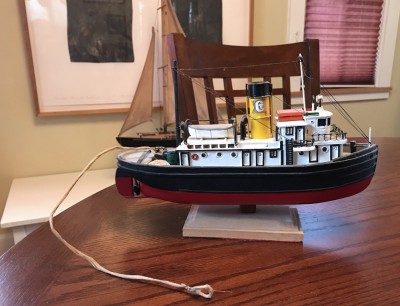
Testimony in suits brought by the estates of the dead revealed that the tug suffered a multitude of operational problems, not the least of which was its tendency to heel over precipitously while towing Cleveco. A comparison of photographs of the W. H. Meyer and Cleveco would lead any sentient being to believe that as rebuilt the overall seaworthiness of Admiral was questionable. An initial court ruling and a subsequent appeal ruled Cleveland Tankers was aware of the unseaworthiness of Admiral, rejecting limitations of liability and allowing the estates to sue. Here is a model of Admiral I acquired from the son of the man who built it, a memorial to a good friend of his father lost in the foundering. The vessel had inherited the triple expansion steam engine of the first W. H. Meyer of 1899, built by Sheriffs.
- Attachments
-
Buckeye Tankers, Inc., a subsidiary of Cleveland Tankers, Inc., itself a subsidiary of Allied Oil Transport, Inc., bought [I]Gotham 84[/I] and [I]Gotham 85[/I] from Gotham Marine Corporation shuttle finished petroleum products between its terminal at Whiskey Island and its storage facility at Toledo. [I]Gotham 84[/I] was to be paired with the tug [I]William A. Whitney[/I], but this never happened. Investment in a powered tanker for this relatively short haul made no sense, while with the war raging the possibility of acquiring such a vessel was nil. The two vessels had nominal crews of ten apiece, but when the tragedy occurred the tug carried thirteen and barge seventeen. The venerable Milwaukee Tug Boat Line was disposing of its fleet, unable to reach a contract with Local 8 of the Licensed Tugmen's Protective Association, and sold the [I]W. H. Meyer[/I] to Cleveland Tankers 16 June 1942 for conversion to a cross lake tug to tow the [I]Gotham 85[/I], later renamed [I]Cleveco[/I]. The tug arrived at Cleveland 22 June 1942 and was sent to the G. A. Henrickson Company for conversion that consisted of extensive remodeling of its superstructure. After its completion in September inclination tests were conducted on the vessel. Here is the report of 11 September 1942 from the naval architect hired to execute the test:
"Examination of the foregoing data (stability data) indicates that the subject vessel is slightly deficient in stability and the following restrictions should be observed in the operation thereof:
"(1) Vessel should not be operated at a mean keel draft in excess of 11'-0" or at more than 2'-3" trim by the stern when at this draft.
"(2) Bilges should be maintained well pumped out.
"(3) Tow line should be maintained in as nearly a fore and aft line as practicable.
"If it is found impracticable in operation to limit the draft to 11'-0" the permissable draft evidently may be increased by building up the deck at the low point of the sheer so as to increase the depth at this point by at least the amount of the desired increase in draft. Plans for such alteration should be submitted for approval."
Testimony in suits brought by the estates of the dead revealed that the tug suffered a multitude of operational problems, not the least of which was its tendency to heel over precipitously while towing [I]Cleveco[/I]. A comparison of photographs of the [I]W. H. Meyer[/I] and [I]Cleveco[/I] would lead any sentient being to believe that as rebuilt the overall seaworthiness of [I]Admiral[/I] was questionable. An initial court ruling and a subsequent appeal ruled Cleveland Tankers was aware of the unseaworthiness of [I]Admiral[/I], rejecting limitations of liability and allowing the estates to sue. Here is a model of [I]Admiral[/I] I acquired from the son of the man who built it, a memorial to a good friend of his father lost in the foundering. The vessel had inherited the triple expansion steam engine of the first [I]W. H. Meyer[/I] of 1899, built by Sheriffs.